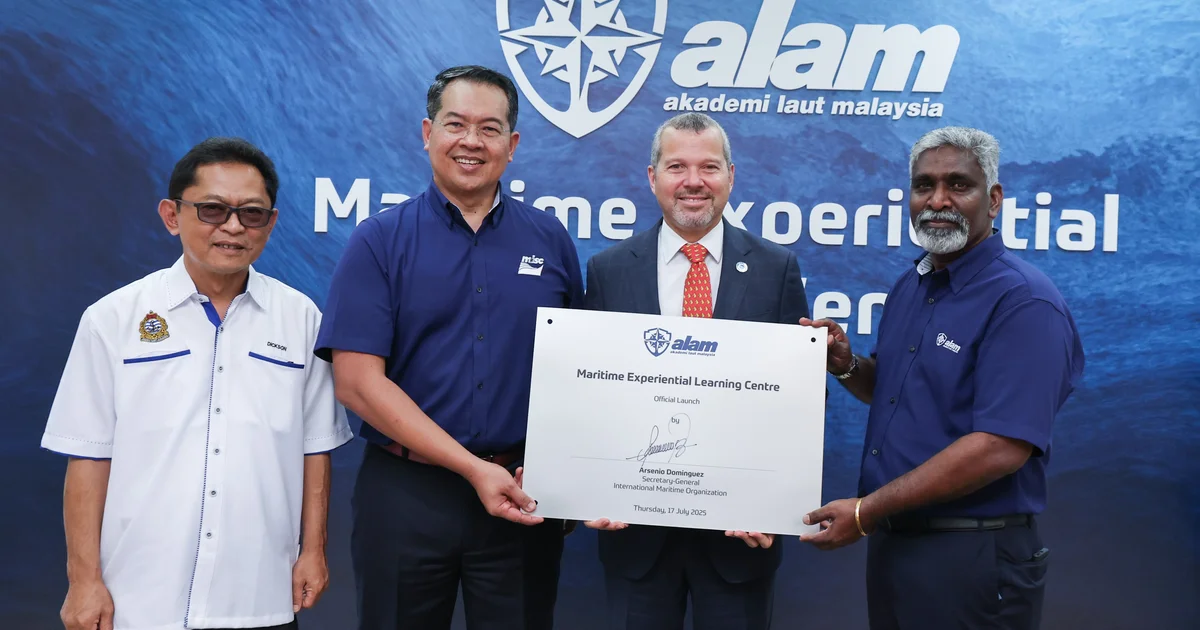
Akademi Laut Malaysia (ALAM) has officially launched its groundbreaking Maritime Experiential Learning Centre, pioneering advanced seafarer training with state-of-the-art simulation technology in the Asia Pacific region. The newly inaugurated centre, recognized as the first MASTER Centre (Maritime Advancement in Simulation Technology & R&D Services) in the region and endorsed by Wärtsilä, leverages cloud-enabled simulators to thoroughly replicate real-world vessel operations. This initiative marks a significant advancement in maritime education and training capabilities. The launch event was officiated by Arsenio Dominguez, Secretary-General of the International Maritime Organization (IMO), during his inaugural visit to Malaysia.
The simulator hub features cutting-edge training tools, including high-definition visuals, integrated virtual reality systems, remote learning capabilities, and automated performance grading mechanisms. Designed to prepare seafarers for evolving industry demands, the centre emphasizes essential skills development in decarbonisation practices, digitalisation strategies, and smart navigation systems—critical areas identified as driving forces in the future of maritime operations.
The launch coincided with Malaysia Maritime Week 2025, where Dominguez also engaged directly with over 250 students in an interactive session titled “Malaysia Maritime NextGen.” The session focused on fostering innovation and strengthening the maritime education sector in Malaysia, highlighting the urgency for the industry to adapt to emerging technologies and sustainability mandates. ALAM’s initiative aims to elevate Malaysia’s standing within the global maritime community through forward-thinking education strategies tailored to modern industry needs.
Why this matters
The establishment of ALAM’s Maritime Experiential Learning Centre sets a new benchmark for maritime simulation-based training, especially within a region heavily reliant on shipping as an economic cornerstone. By adopting advanced technologies such as cloud-based simulators and virtual reality, the centre equips aspiring seafarers with the practical skills necessary to operate in increasingly complex vessel environments driven by decarbonisation and digital innovation.
This move is particularly significant given the global maritime industry’s transition towards greener, smarter practices, aligning closely with IMO targets for emissions reductions and digitalisation adoption. ALAM’s focus on automated grading mechanisms and remote training also reflects a broader shift towards scalable and accessible education solutions, addressing workforce shortages and promoting skill development across Asia Pacific.
Industry stakeholders—including shipowners, operators, and training providers—stand to benefit from a more skilled and technologically savvy seafaring workforce entering the market. The emphasis on sustainability and digitalisation-focused training ensures compatibility with future regulations and operational demands, positioning operators to achieve compliance while maximizing operational efficiency.
The Maritime Experiential Learning Centre is expected to accelerate Malaysia’s reputation as a regional leader in maritime innovation and sustainability practices. With focus areas such as smart navigation and decarbonisation, the centre is set to influence broader industry training standards, encouraging other nations in the Asia Pacific to adopt similar advanced technologies and educational frameworks that match evolving global demands.