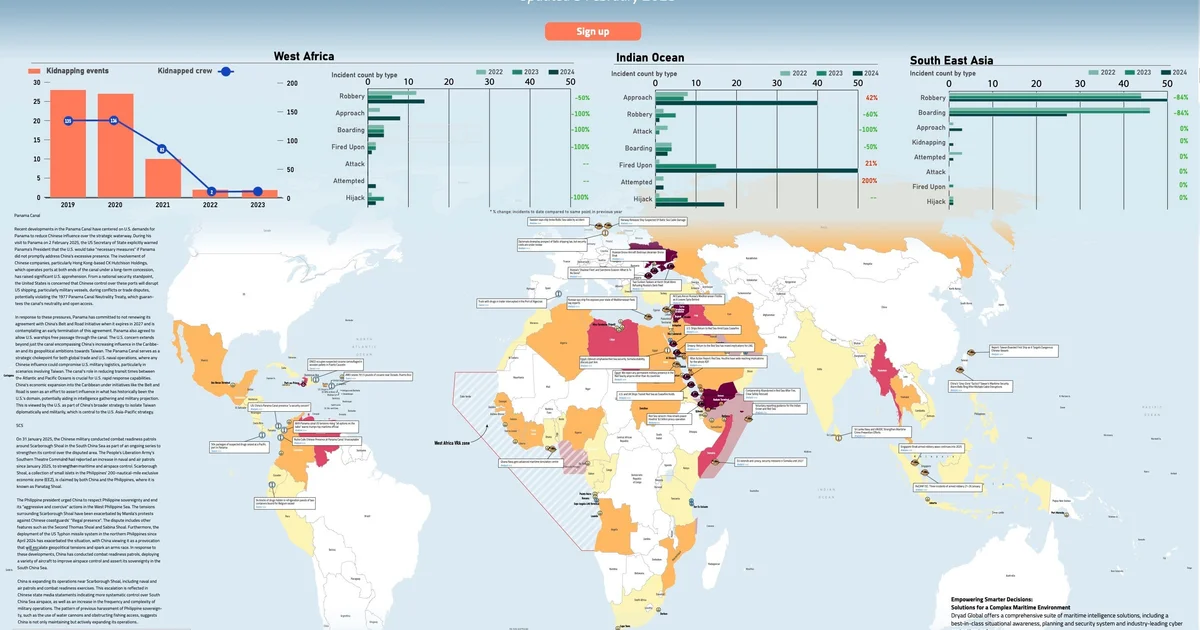
The latest Maritime Security Threat Advisory (MSTA) from Dryad Global, dated February 3, 2025, emphasizes critical security issues and geopolitical developments affecting the maritime sector. Here are the primary insights from the report:
Heightened Tensions in the Panama Canal
The report underscores escalating U.S.-China tensions centered around the Panama Canal. A recent visit by the U.S. Secretary of State to Panama highlighted American apprehensions regarding Chinese influence in the area. The U.S. has expressed concerns that Chinese operations could compromise military logistics and commercial shipping routes, especially amid geopolitical conflicts. In response to U.S. pressures, Panama has vowed to terminate its involvement in China’s Belt and Road Initiative by 2027 and has permitted unrestricted passage through the canal for U.S. warships. This shift indicates a growing U.S. vigilance over China’s reach in the Caribbean, which Washington perceives as a threat to its historical dominance in the region.
South China Sea: Increased Chinese Military Activity
In the South China Sea, China’s military presence is intensifying, particularly near Scarborough Shoal, which falls within the Philippines’ Exclusive Economic Zone (EEZ). The People’s Liberation Army (PLA) has ramped up both naval and air operations, marking the area as a significant flashpoint in regional tensions. The Philippines has criticized China’s escalating maritime activity as aggressive and coercive. Additionally, the U.S. has deployed its Typhon missile system in the northern Philippines, further straining relations and prompting China to boost its military patrols.
Red Sea Security: Ceasefire Yet Imminent Risks
In the Red Sea, a fragile ceasefire has been holding, yet commercial shipping remains at risk. Instances of piracy, particularly from Houthi groups, have resulted in substantial financial losses due to ransom demands and operational disruptions. Recent incidents include the abandonment of a containership post-fire, along with ongoing high-risk transit for U.S. and UK vessels.
Developments in the Baltic and Mediterranean
Key incidents have occurred in the Baltic and Mediterranean seas. Norwegian authorities have released a vessel previously thought to have damaged an undersea cable, citing lack of evidence. Meanwhile, a fire aboard a Russian spy ship in the Mediterranean has raised alarms regarding the state of Russia’s naval capabilities, suggesting deficiencies in maintenance and operations. The EU has also extended its anti-piracy missions in Somalia through 2027, illustrating the ongoing maritime crime threat in that region.
Drug Trafficking & Maritime Crime Trends
Maritime law enforcement continues to report significant drug seizures globally. These include 791.5 pounds of cocaine intercepted near Puerto Rico and over 500 drug packages in Panama, emphasizing its role as a critical smuggling route. Sri Lanka, alongside the UNODC, is bolstering efforts against drug trafficking and human smuggling in the Indian Ocean.
Rising Incidents of Piracy and Robbery
The advisory indicates a worrying trend of increased piracy and armed robbery at sea. Notable incidents have been reported in the Singapore Strait, prompting new security advisories for vessels. In Southeast Asia, the ReCAAP ISC recorded several incidents, while West African waters continue to face challenges from piracy attempts.
Overall, the MSTA from February 2025 illustrates a complex landscape of maritime security threats, highlighting the need for vigilance from the global maritime industry in light of these escalating geopolitical tensions, piracy engagements, and drug trafficking activities.