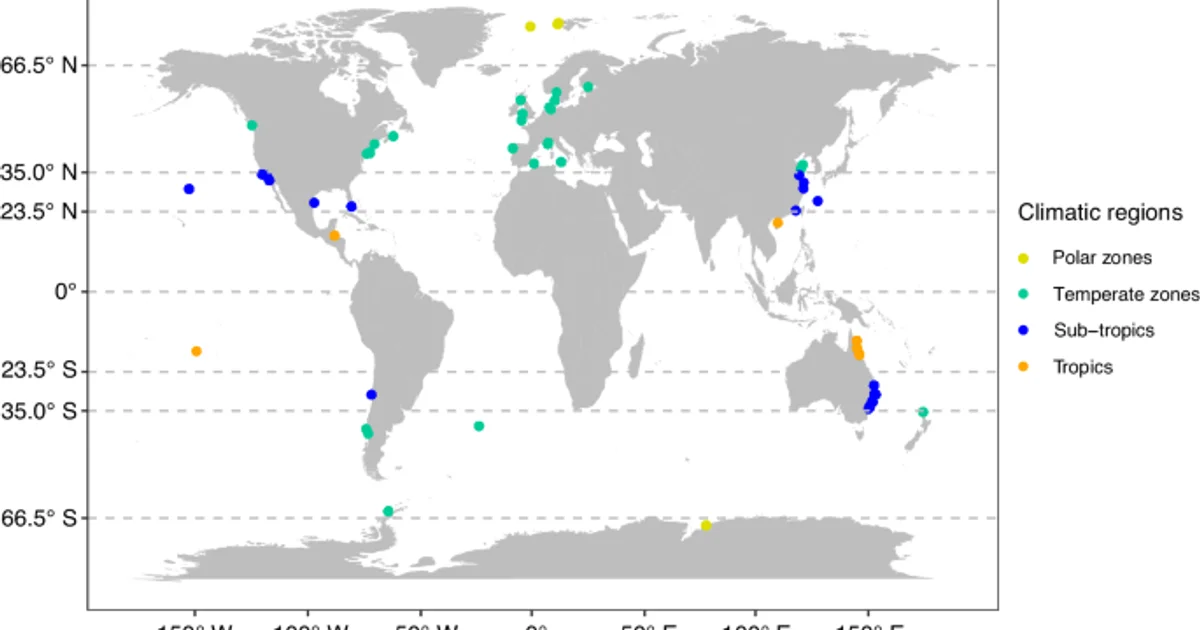
Ocean acidification and rising temperatures are increasingly altering the dynamics of marine ecosystems, with significant implications for food web structures and biodiversity. Recent studies highlight that the combined effects of these stressors jeopardize the stability of trophic levels and the functioning of global marine environments.
Research led by Parmesan (2006) reveals that climate change is driving ecological shifts, disrupting species distributions, phenology, and community structures across various ecosystems. The warming of oceans is forcing species to adapt to altered habitats, which destabilizes established biodiversity and interactions. This disruption is particularly pronounced in regions experiencing rapid temperature increases.
Further findings by Doney et al. (2009, 2012) point to ocean acidification as a critical consequence of increased atmospheric CO2 levels. The drop in pH affects calcifying marine organisms such as corals and shellfish, which play foundational roles in ecosystem stability. Acidification impacts nutrient cycles and food web dynamics, with the potential to cascade through entire ecosystems.
On the trophic level, Nagelkerken et al. (2020) observe significant changes in food web structures when marine ecosystems fail to reorganize under shifting ocean conditions. This lack of adaptive capacity leads to inefficient energy transfers across trophic levels, reducing ecosystem productivity and resilience. Such inefficiencies underscore vulnerabilities in food web architecture.
Sensitivity to these stressors, however, varies widely among species. Vargas et al. (2022) highlight that marine invertebrates exhibit different levels of resilience to acidification, challenging generalized assumptions about species adaptability. Variability in sensitivity demands tailored conservation approaches to safeguard vulnerable populations.
Kroeker et al. (2010) and Hu et al. (2022) focus on the interaction between simultaneous stressors, emphasizing that temperature and acidification often elicit inconsistent responses across marine life. While certain species exhibit adaptive benefits under higher CO2 levels, others face serious threats to survival. These findings complicate predictions about ecological responses and call for nuanced management strategies.
Biodiversity plays a crucial role in ecosystem functioning, according to studies by Côté et al. (2016) and Jackson et al. (2021). Their research underscores the risks posed by declining biodiversity, driven by anthropogenic stressors, to overall ecosystem health. Conservation strategies must consider complex interactions between stress factors to safeguard ecological integrity effectively.
In conservation-focused research, Brown et al. (2013) and Ghedini et al. (2013) advocate for adaptive management frameworks capable of addressing these compounded challenges. Local interventions, such as habitat restoration and carbon mitigation, are necessary but must align with broader global measures to restore balance in marine ecosystems.
Why this matters
Ocean acidification and warming present operational challenges for industries dependent on marine biodiversity, such as fisheries and aquaculture, as key species become increasingly vulnerable. Disruptions to trophic levels could reduce fish populations and alter harvest yields, affecting global seafood supply chains. Ports and shipping operators reliant on healthy coral reef systems for coastal protection may face elevated risks from degraded ecosystems.
The broader impacts extend to regulatory pressure on shipowners and operators. Industries contributing to global CO2 emissions could face stricter mandates as international bodies prioritize measures to combat acidification. Additionally, insurance sectors handling risks associated with coastal infrastructure may need to reassess exposure to rising sea levels and degraded marine environments.
Understanding species-specific sensitivity variances will be critical for targeted investment and conservation planning. Governments and NGOs must collaborate with scientific bodies to deploy region-specific strategies aimed at balancing ecological restoration with industry needs, particularly in heavily fished areas and coral reef zones.
Looking ahead, scientific research must focus on resilience-building measures for marine ecosystems while navigating climate change uncertainties. Stakeholders across maritime sectors will need to anticipate regulatory pushes and supply chain disruptions induced by these ecological shifts. The interplay between acidification and temperature is set to emerge as a pivotal area for maritime risk management and conservation action.