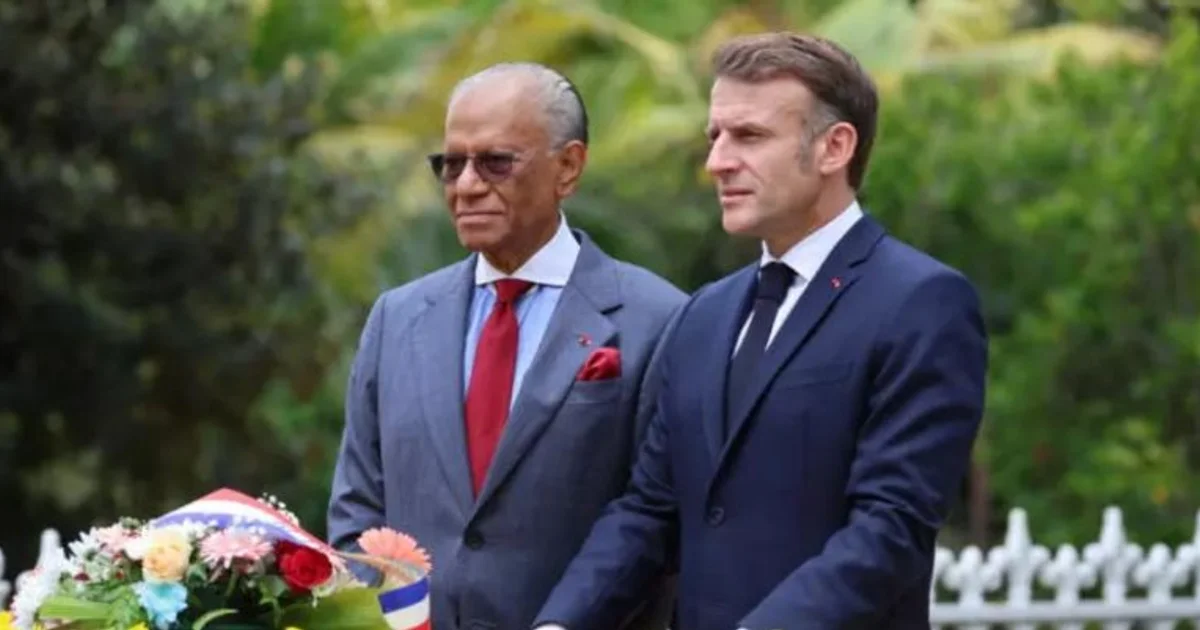
French President Emmanuel Macron and Mauritian Prime Minister Dr. Navinchandra Ramgoolam convened in Port Louis during Macron’s first official visit to Mauritius in 32 years, spotlighting maritime security and oceanic cooperation as central themes in bilateral discussions. Held at the Sir Harilal Vaghjee Memorial Hall, the talks produced actionable agreements that aim to bolster regional maritime governance and advance marine conservation efforts within the Indian Ocean basin.
President Macron praised Mauritius’ proactive stance in signing the Marine Biodiversity of Areas Beyond National Jurisdiction Treaty, underscoring its importance in global efforts to protect oceanic ecosystems. He further announced forthcoming agreements to strengthen maritime security, including initiatives to combat illegal fishing and improve surveillance of exclusive economic zones shared by Mauritius, France, and Réunion Island. Additionally, technical assistance from Agence Française de Développement (AFD) and Électricité de France (EDF) has been pledged for ocean protection, renewable energy optimization, and the sustainable management of marine resources.
Prime Minister Ramgoolam emphasized the strategic significance of French support for Mauritius’ national and regional maritime priorities. He noted that the agreements extend to the blue economy, renewable energy projects, and integrated water management — all vital components of Mauritius’ drive for sustainability in coastal and marine operations. Citing France’s historical contributions to Mauritius since its independence in 1968, Ramgoolam expressed gratitude for France’s commitment to maritime reforms and for its stance on pressing geopolitical issues, such as anti-corruption and maritime crime.
The private sector was also highlighted in the discussions. Ramgoolam acknowledged partnerships such as those with the Mauritius Sugar Syndicate and Moulin de la Concorde, focusing on supply chain logistics and coastal resilience projects supported by AFD. Broader economic links between the two nations were reinforced, with 340,000 French tourists visiting Mauritius last year, indicating a strong interconnection between tourism, financial services, and international trade. France maintains a robust presence in sectors critical to Mauritian infrastructure, including energy, logistics, and water resource development.
Why this matters
As Mauritius navigates growing challenges associated with climate change and maritime security, the strengthening of its partnership with France signals enhanced regional cooperation in safeguarding marine ecosystems and ensuring the safe transit of vessels through Indian Ocean waters. Mauritius’ alignment with international treaties like the Marine Biodiversity Treaty establishes its role as a steward of global ocean conservation, which could directly impact its maritime economy and regulatory posture.
The emphasis on technical assistance from French agencies such as EDF and AFD is likely to accelerate projects in sustainable marine resource management, aiding Mauritian ports and operators in achieving compliance with evolving environmental mandates. Further, collaboration on anti-trafficking and maritime surveillance may reduce risks for commercial vessels operating near Mauritius and Réunion, offering shipowners improved security in regional transit lanes.
Looking ahead, the evolving bilateral agreements between Mauritius and France are poised to strengthen maritime infrastructure and cross-border synergies, particularly in the domains of marine biodiversity protection and maritime safety enhancements. The strategic depth of cooperation signals not only regional benefits but also positioning Mauritius as a pivotal player in Indian Ocean governance.