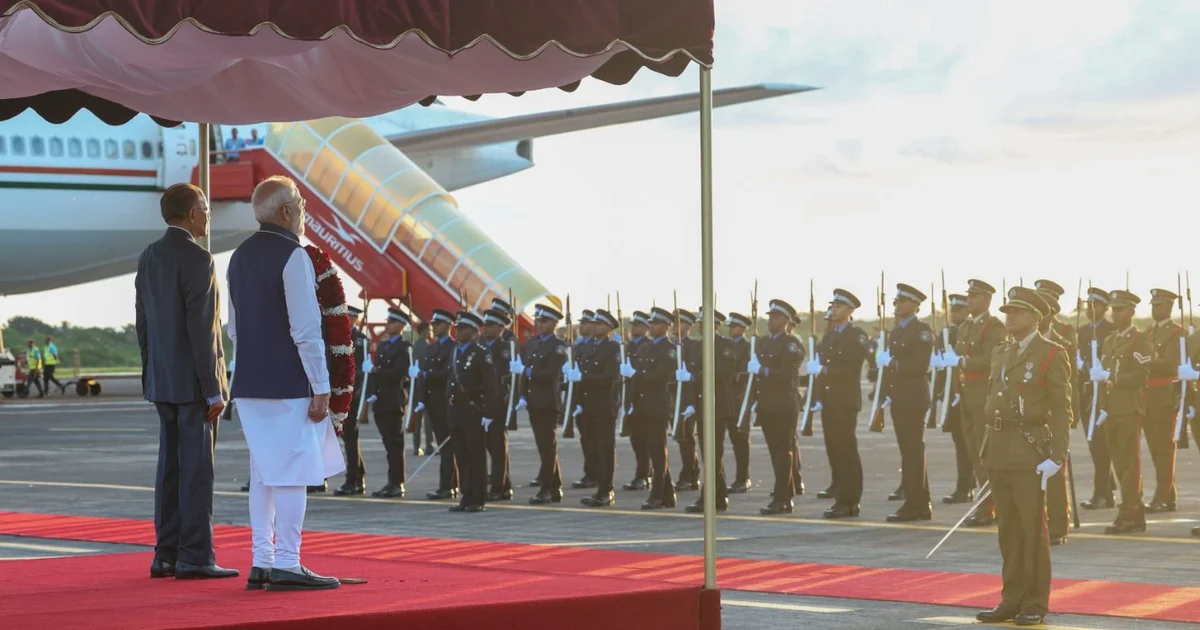
In early 2023, Indian Prime Minister Narendra Modi unveiled the MAHASAGAR initiative, standing for Mutual and Holistic Advancement for Security and Growth Across Regions, during an official visit to Mauritius. This marks a strategic evolution from his earlier program, SAGAR (Security and Growth for All in the Region), launched in 2015. While SAGAR has primarily emphasized regional maritime security and cooperation within the Indian Ocean Region (IOR), MAHASAGAR broadens that scope, incorporating key areas such as economic diplomacy, technological connectivity, and environmental sustainability. This signals India's intention to transition from a regionally-focused maritime strategy to a globally-influential framework.
Over the last decade, SAGAR has delivered measurable advancements in the realms of Maritime Domain Awareness (MDA), humanitarian assistance and disaster response (HADR), and naval diplomacy. Notably, the establishment of the Information Fusion Centre-Indian Ocean Region (IFC-IOR) in 2018 has fortified real-time information sharing across 28 nations, aiding maritime security operations and efforts to combat illegal activities such as piracy and unregulated fishing. India has also garnered recognition for facilitating humanitarian initiatives, such as vaccine distribution during the COVID-19 pandemic and wide-reaching disaster relief missions.
Despite these achievements, operational and strategic hurdles hinder India's full maritime potential. Observers have pointed out that SAGAR’s guiding principles often lean toward generality, lacking specific institutional frameworks akin to China’s far-reaching Belt and Road Initiative (BRI). As India advances MAHASAGAR, experts advocate for the development of a formal policy document delineating clear objectives, defined stakeholder roles, resource allocation, and implementation pathways to bolster the efficacy of its maritime agenda.
In moving beyond security-centric frameworks, India’s strategy must align with the priorities of IOR nations, which often center on infrastructure development and economic progress. SAGAR's heavy focus on security thus far has been seen as limiting broader economic partnerships and developmental collaboration, both of which are vital for strengthening bilateral and multilateral ties in the region. Concurrently, environmental challenges such as climate change, pollution, and overfishing pose severe risks to marine ecosystems and the livelihoods of coastal communities. Addressing these concerns through cooperative regional frameworks will not only preserve ecological health but also bolster India's credibility as a responsible maritime stakeholder.
The rollout of MAHASAGAR underscores Modi's vision of positioning India as a first responder and trusted security partner in the Indian Ocean, bolstered by multilateral maritime exercises and enhanced collaborative MDA mechanisms. Strategic programs aimed at inclusive economic growth and sustainability could further counterbalance China’s growing influence in the region and reinforce India's leadership on both regional and global maritime stages.
Why this matters
India’s shift from SAGAR to MAHASAGAR reflects a growing recognition within the government that the nation’s maritime ambitions require a globally-inclusive approach. By pivoting toward a comprehensive framework that balances security with economic diplomacy and environmental priorities, India has the opportunity to expand its sphere of influence not just in the IOR but on the global stage.
Operationally, this evolution demands improved resource deployment and institutional coordination, as bottlenecks in policy and resource-use have previously undermined SAGAR’s full potential. For port operators, shipping companies, and infrastructure developers within the region, closer cooperation with Indian initiatives may mean expanded project opportunities, especially in areas where sustainability and economic development intersect.
From a geopolitical standpoint, MAHASAGAR is poised as a direct countermeasure to China’s increasing dominance, especially as the BRI initiative integrates ports and maritime corridors globally. Strengthening maritime domain awareness and humanitarian response capability allows India to pose as a credible alternative partner for IOR nations seeking less asymmetric dependencies.
Furthermore, maritime segments tied to environmental advocacy—such as eco-friendly shipping, renewable energy harnessing, and sustainable fishing—stand to benefit from India's broader inclusion of environmental goals in its MAHASAGAR framework. This would elevate India’s role as a leader in sustainable maritime practices at a time when marine ecosystems face mounting pressure.
In the immediate term, the formulation and release of MAHASAGAR’s formal policy document will be pivotal to its overall effectiveness. The industry will look toward clear commitments on resource allocation and timelines for maritime security enhancements, infrastructure projects, and environmental initiatives. As stakeholders await this strategic clarity, maritime operators and governments within the IOR should closely monitor how India finalizes and executes MAHASAGAR’s ambitious goals.