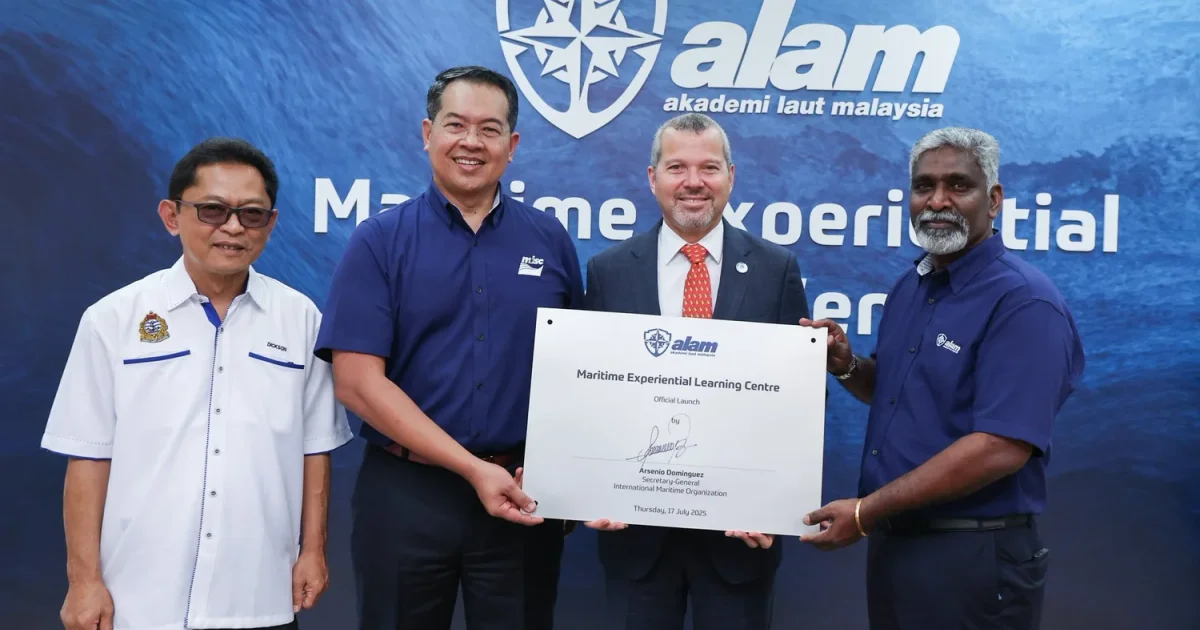
Malaysia’s premier maritime training institution, Akademi Laut Malaysia (ALAM), has launched its state-of-the-art Maritime Experiential Learning Centre, a facility designed to enhance the practical training of future seafarers through advanced simulator technology. The official inauguration took place during Malaysia Maritime Week 2025 and was officiated by Mr. Arsenio Dominguez, Secretary-General of the International Maritime Organization (IMO), as part of his maiden official visit to the country.
This innovative training hub is the result of a strategic partnership between ALAM and Wärtsilä, a global leader in smart marine technology. The facility is equipped with next-generation, cloud-enabled simulators capable of rendering highly realistic vessel operation scenarios. Designed to closely replicate real-world maritime conditions, these simulators allow trainees to immerse themselves in operational environments and experience main vessel functions virtually, preparing them to respond effectively to practical challenges encountered at sea.
In recognition of its technological capabilities, ALAM has been designated by Wärtsilä as its first MASTER (Maritime Advancement in Simulation Technology & R&D Services) Centre in the Asia Pacific region. This formal endorsement positions ALAM as a key player in driving maritime training innovation, while underlining Wärtsilä’s confidence in ALAM’s ability to deliver high-standard education aligned with the demands of modern maritime operations.
ALAM, part of the MISC Group, has emphasized its commitment to leveraging cutting-edge solutions to address the complexities of the global maritime industry. The institution’s investment in smart training technologies reflects its mission to elevate professional standards and cultivate highly skilled maritime graduates equipped for today’s dynamic and evolving shipping landscape.
Why this matters
The launch of the Maritime Experiential Learning Centre represents a significant development in the ongoing efforts to modernize seafarer training in Southeast Asia, a region critical to global shipping routes. By equipping trainees with technology that simulates real-world ship operations, ALAM is addressing the increasingly technical skill requirements of the industry as vessel operations grow more digitized and automated.
For shipowners and operators, access to graduates exposed to realistic operational training scenarios reduces risks associated with inexperience, potentially impacting vessel safety and efficiency positively. Furthermore, ALAM’s designation as a MASTER Centre strengthens Malaysia's role as a hub for maritime education and research, paving the way for enhanced talent pipelines in shipping.
This initiative also aligns with international regulatory and training standards set by the IMO and the STCW Convention, ensuring that seafarers trained under this program meet globally recognized benchmarks for competency.
As the facility becomes fully operational, maritime operators should observe how its graduates contribute to bridging skill gaps and reinforcing operational reliability aboard vessels. Malaysia’s emerging prominence in maritime MET capabilities is likely to attract shipping stakeholders seeking advanced training frameworks, as the region continues adapting to technological changes in the global industry.