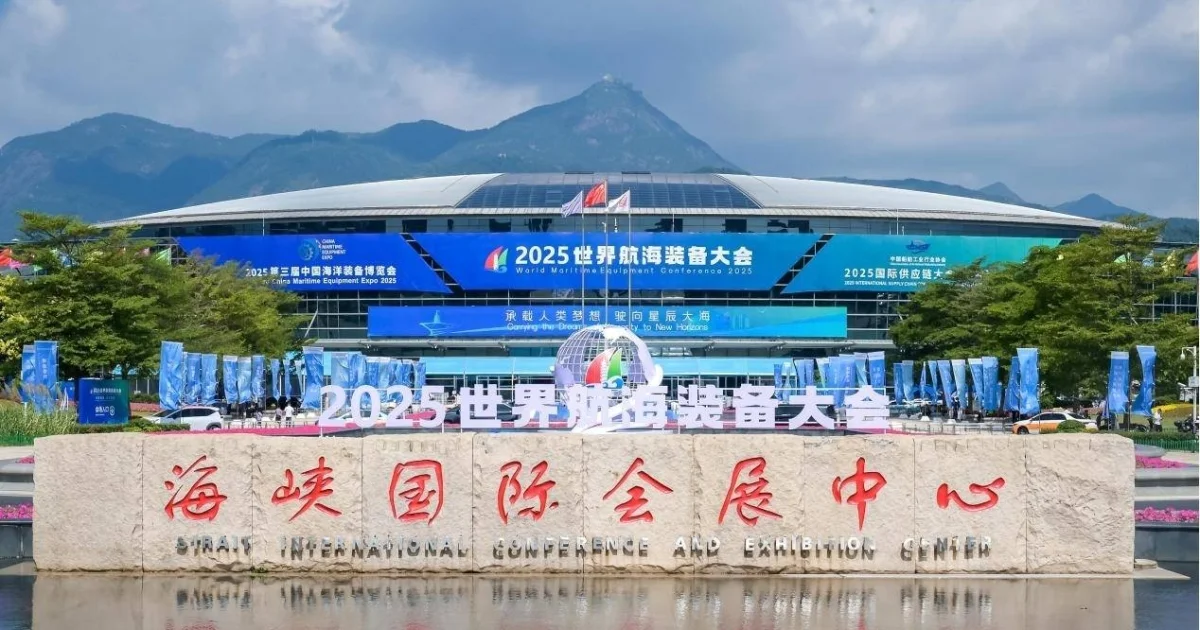
The 2025 World Maritime Equipment Conference officially opened on October 16 in Fuzhou, the capital of China’s Fujian Province, under the central theme “Setting Sail for Greener Development.” Organized by the People’s Government of Fujian Province, the event will run through October 19, offering a diverse range of forums, exhibitions, and discussions tailored to advancing innovation and sustainability within the maritime sector.
Among the highlights of the conference is the Fujian Marine Economy Industry Cooperation and Innovative Development Conference, alongside the Maritime Equipment Conference Forum. The agenda delves into natural sciences, marine economy advancements, and industrial innovation linked to technological applications, with a key emphasis on Fujian Province’s initiatives to establish National Marine Economy Demonstration Zones. These zones serve as important drivers of economic growth for the region and are positioned to play a significant role in setting benchmarks for sustainable marine industry practices.
The event also marks the inaugural Maritime Innovation “Five-Chain Integration” Promotion Event, an effort to bring together stakeholders across the global industrial chain. Participants include upstream and downstream enterprises, research institutions, and service organizations, all aiming to foster an integrated and collaborative ecosystem for maritime equipment development. Additionally, the "Industry-Research Integration" initiative is being launched to accelerate the commercial adoption of scientific advancements.
The conference runs in parallel with the 3rd China Maritime Equipment Expo, which features 12 specialized exhibition zones. This year’s edition includes representation from companies hailing from 25 nations, with the Netherlands serving as the Guest of Honor. Other associated events include the 2025 International Maritime Organization Seminar on Sustainable Maritime Innovation, the 2025 Fuzhou International Sailing Regatta, and a Marine Industry Integrated Innovation Competition, all of which underline the event's emphasis on eco-friendly innovation and strategic collaboration.
Since its launch in 2023, the World Maritime Equipment Conference has reportedly facilitated investment and trade agreements exceeding 300 billion yuan, underscoring its far-reaching impact on synergizing industrial growth with ecological sustainability. Building upon this momentum, the 2025 gathering aims to further establish its role as a global nexus for driving advancements in maritime equipment and fostering partnerships across the marine economy.
Why this matters
The conference holds strategic significance for maritime operators, equipment manufacturers, and related industry stakeholders, particularly as the sector faces increasing pressure to invest in sustainable practices. Fujian Province’s National Marine Economy Demonstration Zones focus on harmonizing economic expansion with ecological priorities, offering a model for other regions to emulate.
The introduction of the “Five-Chain Integration” Promotion Event highlights the growing need for collaboration across supply chains, research bodies, and service providers, especially in navigating the dual challenges of innovation and decarbonization within the industry.
With participation from 25 countries, including major global players, and the Netherlands as Guest of Honor, the event also serves as a platform for fostering international partnerships that can redefine maritime equipment markets worldwide. Concurrent forums like the IMO Seminar further underline the urgency of addressing sustainability goals that align with stricter regulatory frameworks.
The presence of specialized exhibition zones and integrated innovation competitions showcases actionable efforts to transform R&D advancements into deployable maritime technologies. Industry stakeholders are encouraged to leverage these developments for strategic growth while aligning with environmental compliance.
As the conference progresses, maritime operators and manufacturers will be keenly observing new investment agreements and technological solutions emerging from the discussions, which are likely to reshape equipment supply chains and bolster global collaboration in sustainable marine economic practices.