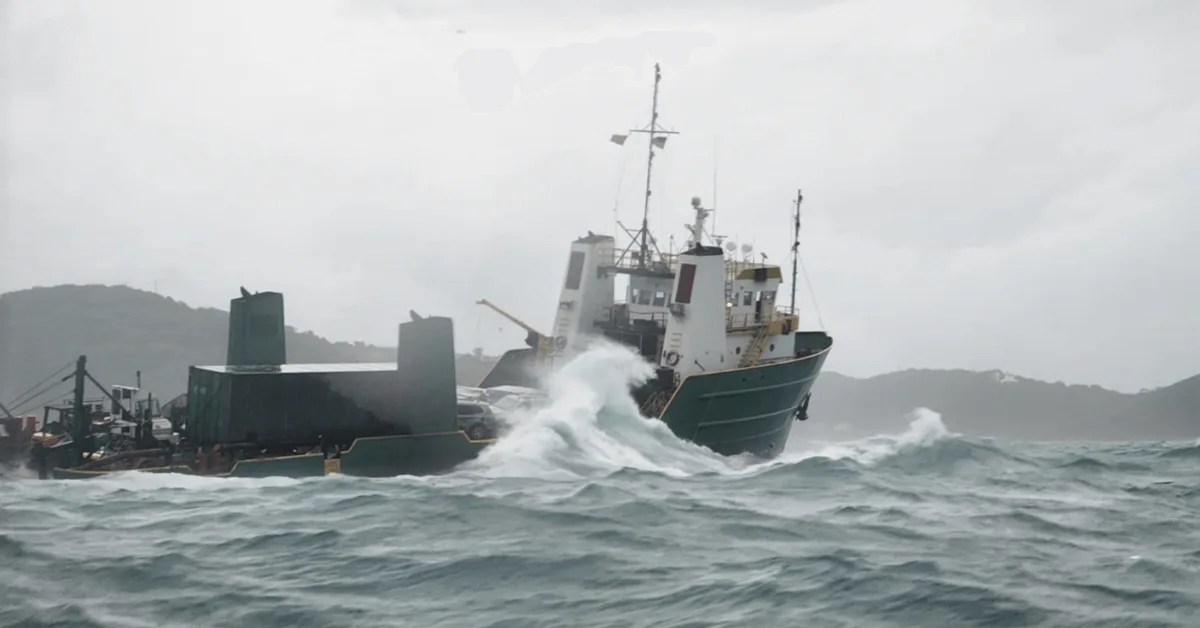
Cargo vessel Bonnie G was declared a total constructive loss after running aground near St. Thomas in the U.S. Virgin Islands on October 4, 2023. The National Transportation Safety Board (NTSB) attributed the incident to insufficient anchor chain deployment, compounded by navigational and procedural errors made by the captain. The vessel had been waiting for adverse weather conditions to clear when the anchor failed, allowing the ship to drift uncontrollably toward the shore.
The vessel, crewed by 12 personnel, had arrived at Crown Bay following forecasts predicting wind speeds of 10-15 knots, with gusts up to 25 knots overnight. However, upon arriving, Bonnie G’s designated docking area was obstructed by a loaded barge, prompting the captain to select anchoring over docking amid worsened conditions. In deploying the anchor, the captain misjudged the water depth, estimating it at 23-26 feet, when in reality it was closer to 68 feet.
Navigational best practices dictate that the anchor chain length should be five to seven times the water depth, meaning the vessel required roughly 340-476 feet of chain in this scenario. Instead, the NTSB found that Bonnie G deployed only 2.5 to 3.5 times the necessary chain length. This miscalculation likely caused the anchor to drag and eventually fail, forcing the vessel to drift. Attempts to regain control ended disastrously when the ship collided with a submerged rock, breaching the hull near the engine room. Seawater flooded the vessel through the breached hull, further exacerbated by the crew’s failure to secure a watertight door in the engine room.
The cargo vessel was valued at $1.5 million and has been classified as a total loss. The NTSB highlighted that the captain’s decisions—the choice to anchor in inadequate conditions, failure to account for local water depths accurately, and neglect to consult navigational charts regarding nearby hazards—all contributed to the grounding incident. Moreover, securing the watertight door could have contained flooding and minimized the damage sustained.
Why this matters
Incidents such as the Bonnie G grounding serve as a stark reminder of the operational risks inherent to poor procedural adherence in anchoring practices. Not deploying an anchor chain proportional to water depth can lead to catastrophic outcomes, as seen here, where insufficient chain length directly contributed to anchor failure and vessel drift. For shipowners and operators, the $1.5 million loss underscores the financial ramifications of small operational oversights.
Mariners also face heightened liability due to local environmental vulnerabilities near St. Thomas and other sensitive locations. Accurate depth estimation combined with deployment of sufficient anchor chain length—five to seven times the water depth—is critical to ensuring vessel stability in adverse weather. The NTSB emphasizes consulting navigational charts and local resources like the U.S. Coast Pilot as safeguards when anchoring in challenging conditions.
This incident reinforces the necessity for captain familiarity with vessel-specific operational guidelines to mitigate risks, particularly in scenarios where docking is not immediately feasible. The oversight in securing the watertight door—a procedural lapse—also highlights the importance of ensuring watertight integrity at critical moments to limit onboard flooding and damage costs.
Looking ahead, operators may expect heightened scrutiny from port authorities and insurers for coastal anchoring operations, demanding strict adherence to chain deployment length and navigational hazard awareness to avoid similar costly incidents. Training programs for deck officers and masters could increasingly target precise depth estimation and anchoring techniques to reduce marine accident rates.